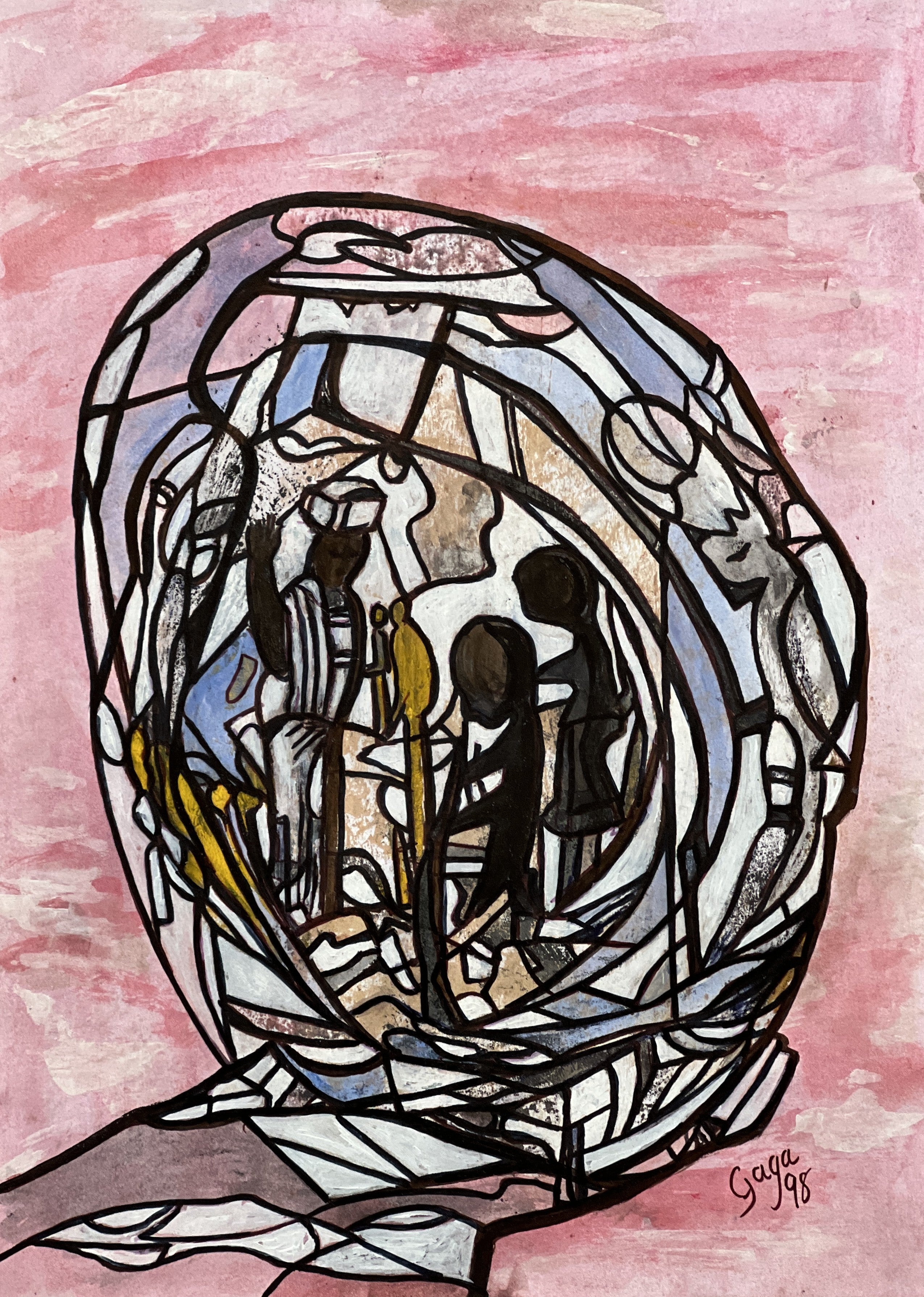

Article: Artist in Focus: Thierry Tomety
Artist in Focus: Thierry Tomety
Giving Form to the Invisible
“They are images without immediate meaning that ask to be embodied.”
This is how Thierry Tomety describes the fragments that enter his work. They do not arrive as completed compositions with convenient explanations attached. They emerge gradually, gathering form through material, intuition and attention.
 Thierry Tomety, Atelier Jardin Rouge, Credit: Mourad Boulhana, courtesy of the artist
Born in Lomé, Togo, in 1993, Tomety is a self-taught visual artist working across painting, collage and sculpture. His textured surfaces explore what cannot always be seen directly: our inner lives, the connections between people, and the uncertain boundary between dreams and reality.
From Software to the Studio
Before becoming an artist, Tomety studied software development. His visual interests began with video editing and graphic design, but at one point he felt drawn back to art through painting.
 Thierry Tomety potrait © the artist
Without formal art-school training, he began studying different periods of art, from the classical to the contemporary. He wanted to understand how art changes with the ways people think. Technique developed through play and experimentation.
“I simply use what I see around me,” he says. “I play like a child discovering things in their environment.”
It is a revealing description of his practice. Tomety is intellectually curious, but he does not enter the studio determined to control every result. Ideas may guide him, but materials are allowed to have opinions of their own.
A Sculptor of the Mind
Tomety’s practice begins with questions.
“Why do I see an invisible thread connecting everything around me?” he asks. “Does everybody notice this invisible thread? What is the limit between dream and reality?”
These questions position his work within what he calls an existential quest. Yet he does not translate philosophy into neat visual answers. Instead, he uses art to remain inside the questions and give them physical form.
 l'espoir d'une renaissance, 120 x 180, Cardboard, sand and acrylic on canvas
Tomety has described himself as a “sculptor of the mind.” By materialising abstract ideas, he hopes to shape thought and encourage viewers to reflect on what they are seeing—and perhaps on what they cannot see.
 Omen Kpevi golotoe, sculpture. ©Thierry Tomety
His visual language develops in fragments. He compares it to words and phrases that initially appear incomprehensible but gradually form coherent sentences. Meaning is not always present at the beginning. Sometimes the image must first acquire a body.
Even then, Tomety cannot begin simply because he has decided to work. Before the idea, image or material comes a particular feeling: the sense that he is ready.
“I can decide to start a work, but the feeling may not be there,” he explains. “So it is the very first thing that comes.”
What Materials Remember
Tomety works with sand, cardboard, paper, fibres, paint and materials found in his surroundings. These choices give his works their layered surfaces, but they are not made for texture alone.
 Connexion à soi-même , 2026, 90 x 120, Acrylic, sand and natural fibers
He believes that environments leave traces on those who inhabit them. By introducing surrounding materials into his practice, he allows something of a place—and his experience within it—to enter the artwork.
“Depending on where I work, my pieces can convey different impressions because my perception and feelings shift,” he says.
The work of American artist Mark Bradford has influenced his interest in rebuilding from matter that has already been altered. Tomety is also drawn to Italian Renaissance representations of the human body. His own figures, however, often move across the line between masculine and feminine appearances. For him, the physical body is an envelope. The more difficult task is to approach what it contains.
 Hundred titles, 2021, 50 x 70 cm, Cardboard, sand, and acrylic on canvas
Colour is similarly intuitive. Tomety may intend to use a particular shade and find that it refuses to belong on the canvas. Although he has a palette, he admits that little is entirely planned: “I almost always surprise myself.”
An Invitation to Look Again
Tomety expects more from the viewer than immediate recognition. Texture allows the work to shift according to the angle from which it is seen. A form that appears settled may change when the viewer moves, looks longer, or returns to it with a different state of mind.
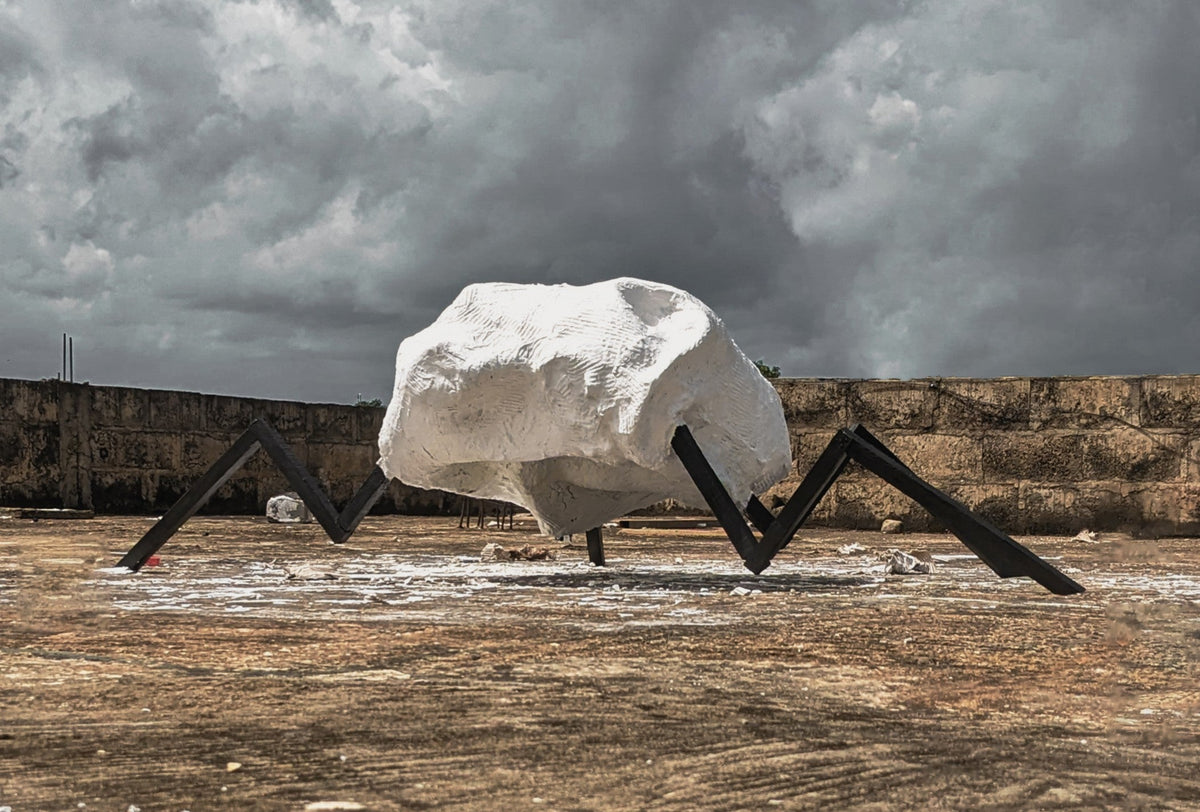
 Omen Gbeto Gbeno, 300 x 300 x 320cm, Credit Mourad Boulhana, ©Thierry Tomety
His interactive sculpture OMEN: GBETÕ-GBENÕ extended this invitation beyond looking. Strangers wrote spontaneous messages for other strangers to receive. For Tomety, the unexpectedly precise encounters that followed expressed his belief that people and experiences may be connected in ways we do not immediately understand.
This openness is central to his practice. He does not ask every viewer to reach the same conclusion. He asks them to give the work time, to question their first impressions and to participate in the search for meaning.
Tomety’s work has been presented at the Palais de Lomé and the Montresso Art Foundation. He participated in the Art Omi residency in New York in 2022 and was a finalist for the 2023 Ellipse Art Prize. As his practice expands towards evolving sculptural works, its central inquiry remains: how can material give presence to something felt but not yet fully understood?
Discover more of Thierry Tomety’s work through unx-art. Continue the Artist in Focus conversation on Instagram and join our WhatsApp channel.